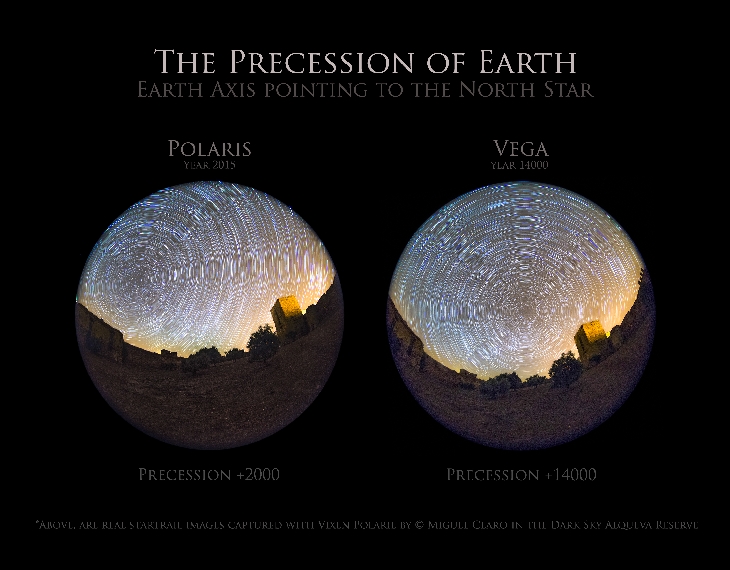
Earth Precession - New Photo Technique showing a Vega “Polar” Startrail
Taken by Miguel Claro on April 19, 2015 @
Alqueva Dark Sky Reserve, Portugal
Click photo for larger image

| |
Camera Used: Unavailable Unavailable
Exposure Time: Unavailable
Aperture: Unavailable
ISO: Unavailable
Date Taken: Unavailable
|
|
| More images
Details:
I would like to contribute in your publication with my newest work and technique to show the Earth Precession.
Since the very first moment I read and learned about the Precession of Earth that I was fascinated with the possibility of having a different star than Polaris, pointing to north, although in that time, few years ago, I didn't had the right technology and even the chance to could show in a real image how it would be...how would be the sky of my land if I had another star in the place of the well known, Polaris ?
After a long time of burning my mind with some new ideias, I figured out how I could do it, developing what I think is, a totally new astrophotographic technique never applied before, and where I can show in real time the sky rotating around another star, simulating the shifting of Earth Axis even being inside our Earth.
In astronomy, axial precession is a gravity-induced, slow, and continuous change in the orientation of an astronomical body's rotational axis. In particular, it refers to the gradual shift in the orientation of Earth's axis of rotation, which, similar to a wobbling top, traces out a pair of cones joined at their apices in a cycle of approximately 26,000 years.
A consequence of the precession is a changing pole star. Currently, Polaris is extremely well suited to mark the position, as Polaris is a moderately bright star located about 0,7º degrees from the pole. But with the crescent light pollution is Increasingly difficult to distinguish the few bright stars in the middle of cities, so near the year 14 000, the brilliant Vega in the constellation Lyra, is touted as the best north star. Although, it never comes closer than 5° to the celestial pole.
When Polaris becomes the north star again around 27,800, due to its proper motion it then will be farther away from the pole than it is now, while in 23,600 BC it came closer to the pole.
What I did to create the both startrails and time lapse images, was to use 2 mountings Vixen Polarie, one to pointing to the actual Polaris Axis and making all the stars staying fixed, but using another Polarie attached to the first one, I could simulate again the Earth Axis Rotation using the sideral motion inverted (I mean, like if I was in the south pole, near the batteries you can switch the button to (N) north or (S) south motion).
But I had special carefully with some things. I have waited until Vega star reach the same altitude I had in my observing latitude, in my case 38º, to have the same distance to the horizon that I have when looking to Polaris.
I had to align carefully the star Vega near the center of the image, to create the axis rotation simulating the 5º separation of the celestial north in +14000 (year). I also used the Live View magnifier with the grid option to have a more precise result.
As this technique induces movement, the landscape will move a bit from the first frame to the last one, but in the final startrail "still image", I made a mask merging the landscape with the first frame again to have a more pleasant result.
All the images were taken from inside the Mourão Castle, in the Dark Sky Alqueva Reserve, the First Starlight Tourism Destination in the world, in Alentejo, Portugal.
Startrail images about Precession:
http://www.miguelclaro.com/wp/?portfolio=the-precession-of-earth-new-photo-technique-showing-a-vega-polar-startrail
Vídeo Time Lapse about Precession:
https://vimeo.com/126868949
Images of the equipment used and described:
http://www.miguelclaro.com/wp/wp-content/uploads/2015/05/Polarie-PosterMC-FullHD-Signed.jpg
Technical info :
Polaris Startrail starts in 19/04/2015 at 23h48 and Vega startrail starts in 20/04/2015 at 1:07
Canon EOS 6D - Canon EF 8-15 f/ 4L Fishseye USM at 8mm (All Sky). Exp. 30 sec. ISO 2500
Photographer's website:
http://www.miguelclaro.com
|
|
|