Calbuco`s Stratospheric Aerosols over Rio
Taken by Helio C. Vital on May 1, 2015 @
Rio de Janeiro, Brazil
Click photo for larger image

| |
Camera Used: Canon Canon PowerShot SX60 HS
Exposure Time: 1/25
Aperture: f/3.5
ISO: 800
Date Taken: 2015:05:01 17:47:47
|
|
| More images
Details:
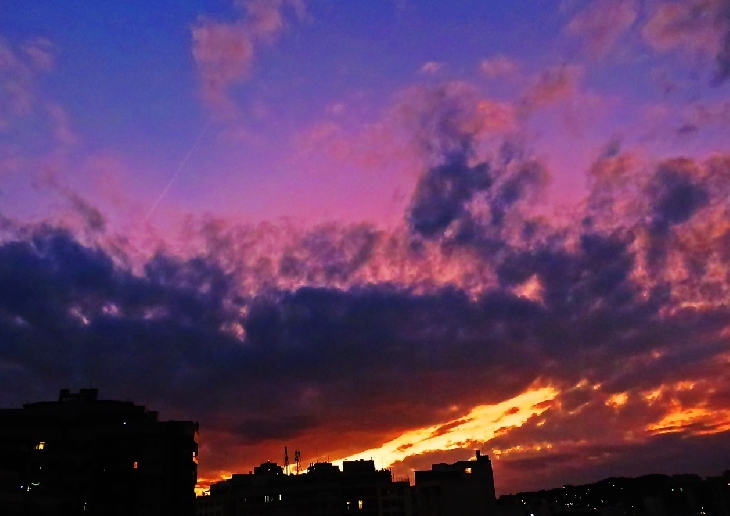
Traces of Calbuco`s aerosols are still being captured by my Canon SX60 camera during 4 minutes only, centered 19 minutes after sunset (currently at 20:47 UT), as these photos show. The brief period of visibility hints at the existence of a very tenuous layer of aerosols. But would that still be at the top of the troposphere (as our photo of a plane passing through it at http://spaceweathergallery.com/indiv_upload.php?upload_id=112236 shows) or in the stratosphere? Intrigued, I came up with a relatively simple way to roughly estimate the altitude "h" of the pink glowing cloud.
From the analysis of these photos, I estimated that the center of the aerosol cloud was w=30°+-3° above the western horizon. I also determined that the cloud faded 20.6 minutes after the predicted time of sunset for my location. Due to Earth`s rotation, that time difference would correspond to a total displacement along Earth`s surface of d=(20.63/60).(15).(3.1416).(6371)km/(180)= 573 km.
In addition, if "d1" is the distance from my observation site to the point from where the aerosol plume would be seen overhead then h/d1 = tan(w) or d1 = h/tan(30).
We also know that the pink glow of the residual plume (detected only by the camera now) vanished when sunlight no longer reached it. In the absence of extensive cloud cover, that is expected to happen when the sun sets upon a depressed horizon d2 km west of it, such that:
(R+h)² = R²+d2² = R²+2Rh+h²=>d2²=h²+2Rh = d2²=h²(1+2R/h), where R is Earth`s radius.
Then, realizing that d=d1+d2= 573 km, we can solve for "h" by using successive iterations such that:
h=d/[1/tan(w)+sqrt(1+2R/h)]; substituting yields: h1=
573/[1/tan(30°)+ sqrt(1+2*6371/h0)]
Entering h0=20km as an initial guess, we then recalculate the altitude as h1=21.05km and so on, until its value no longer changes.
Convergence is quicky obtained after a few iterations. Then, after some testing of associated uncertainties, we come up with:
h=22+-2 km.
That means Calbuco`s lingering traces of aerosol plumes over Rio are now mostly in the stratosphere.
Photographer's website:
http://https://www.flickr.com/photos/98669508@N03/
|
|
|