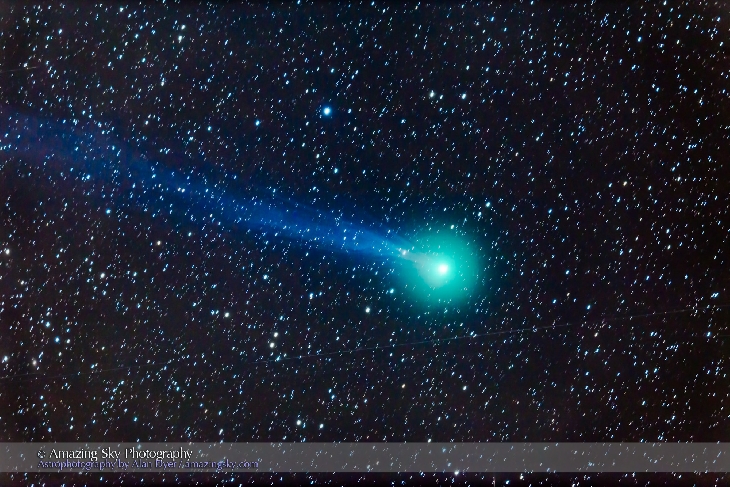
Comet Lovejoy Closeup
Taken by Alan Dyer on January 6, 2015 @ Silver City, New Mexico
Click photo for larger image
  Camera Used: Canon Canon EOS 6D
Exposure Time: 120/1
Aperture: Unavailable
ISO: 1600
Date Taken: 2015:01:06 20:52:57
 
More images
Details:
Clear skies tonight, Tuesday, January 6, allowed me to shoot Comet Lovejoy from home in New Mexico using a telescope and guiding system for a close-up view. I had just over half an hour of darkness between end of twilight at 6:30 and moonrise at 7:15 but that’s all I needed to grab several guided exposures. This telescopic shot takes in a field of about 5 by 3 degrees, a little smaller than what most binoculars would show. The image is a stack of four 2-minute exposures with the telescope guiding on the fast-moving comet. Comet Lovejoy is now at its closest point to Earth and moving fairly rapidly across the sky. So I guided on the comet, letting the stars trail slightly over the 8 minutes of exposure time. The head of the comet glows bright green in photos, from glowing diatomic carbon, while the tail glows blue from other ionized gases streaming away from the head, or coma. The source of it all is a tiny icy nucleus completely hidden from view amid the glowing gases. Comet Lovejoy was easy in binoculars, which showed a bare hint of the tail in dark skies. I could see the comet naked eye, but only by knowing just where to look. It appeared as a slightly fuzzy star, but unless you knew what you were looking at you wouldn’t know it was comet. This is a binocular comet for dark skies. But a very nice binocular comet.
Photographer's website:
http://www.amazingsky.net
Comments
  You must be logged in to comment.  
Alan, great picture. Ive been looking at your website also, those images are fantastic. Im here in Artesia, NM, waiting for some cloudness, non-lunar nights. This picture, what size of lens were you using. Thanks, Bob.
Posted by StargazrVern 2015-01-07 12:10:49
Alan -

Beautiful image of Comet Lovejoy!, especially considering that you had the bright moon to contend with. I am using much less in equipment than you. A three year old Sony NEX5 mirrorless digital camera, APSC sensor, with adapted 40 year old Pentax 135mm f/2.8, and 42 year old Mamiya/Sekor 55mm f/1.4, all piggybacked onto a Celestron Nexstar 5i Cassegrain (or can also shoot the camera straight through the Nexstar 5i 1250mm scope with adapter connection, with stock equatorial motor drive programmed tracking and some guided tracking although through moonlight and light fog last night- tonight I will improve on tracking and try to glean from your excellent equipment and results, Alan.

Im the one that wrote you a few years ago as we compared our Total Eclipse photos of the sun from February 1979, and Ill even link that here again for others inspiration, as it was the old Mamiya/Sekor 1000 DTL with Kodachrome back then, with a poor optical quality 135mm at the time that took these images, miraculously I reprocessed the Kodachromes in new Adobe PS recently to great results! > http://www.dpreview.com/galleries/1579463287/photos/2831396/solareclipse_february1979_sixkodachrometransparenciesreprocessedwithsonynex5digitalcameracopymay2013copyrightbymarkseibold_originalkodachromefilmedgesprocketpunches_5000pxlwidth

As another wrote you here earlier, can you indicate a little more about the lens you used, and/or the telescope & motor mount that you use here?

Thanks again Alan, and i look forward to seeing your great images and well written report that I will share with others today.

Best regards,

Mark Seibold, Retired IT Specialist, Artist-Astronomer, Portland/Sandy Oregon
email: markscosmiclight@gmail.com
Posted by markseibold 2015-01-07 13:57:19
 
The Northern Lights: A Magic Experience
Aurora photo tours
Support SpaceWeather.com
Home | FAQ | Contact the Webmaster
©2019 Spaceweather.com. All rights reserved.