Comet C/2025 R3 (PANSTARRS)
Taken by José J. Chambó on May 18, 2026 @
Rio Hurtado, Chile
Click photo for larger image

| |
Camera Used: Unavailable Unavailable
Exposure Time: Unavailable
Aperture: Unavailable
ISO: Unavailable
Date Taken: Unavailable
|
|
More images
Details:
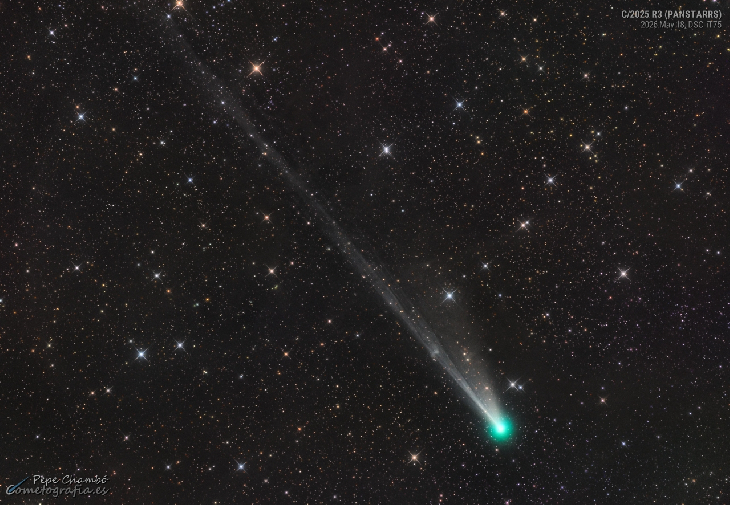
Comet C/2025 R3 (PANSTARRS), imaged on May 18, 2026 at around magnitude 7, was still displaying remarkable activity and one of the most impressive tails seen in any comet this year.
During May I had to switch to remote telescopes, moving from the spring skies of the Northern Hemisphere to the autumn skies of the Southern Hemisphere in order to continue monitoring this comet, the brightest comet of the second quarter of 2026. Although it had already passed both its closest approach to the Sun and to Earth, fading from magnitude 4 to about magnitude 7, it remained a highly active and fascinating object.
The image shows a compact, bright green coma dominated by emissions from diatomic carbon (C₂), with a strong central condensation embedded within a luminous gaseous envelope. Extending from it is a spectacular ion tail stretching beyond 1.7 degrees and continuing well outside the field of view. Its structure is composed of numerous plasma streamers and filaments, including a striking double knot formed by two condensations of ionized material moving so rapidly that their displacement was noticeable from one exposure sequence to the next. Capturing this feature accurately required a dedicated third stack in order to freeze the appearance of an exceptionally dynamic structure.
After perihelion, the comet also developed a prominent dust tail opening into a broad fan above the coma and extending for nearly one degree. Wider and more diffuse than the ion tail, it adds another dimension to the comet's appearance and highlights the different physical processes taking place around the nucleus.
The comet was crossing the constellation Monoceros, a rich Milky Way field threaded with faint interstellar dust clouds. Several dark filaments and extremely subtle nebulous structures can be seen throughout the background, adding depth to the scene and providing a particularly fitting backdrop for this comet's passage.
As the comet continued to fade, the image ended up revealing something even more interesting: its tail was still changing faster than it first appeared.
C/2025 R3 (PANSTARRS) @ 2026-May-18, 23:44 UT
Total Mag= 7.3 [aperture 523"], Dia.= 10.4, Tail= >1.7° PA= 132° (Tycho Tracker)
ASA N250 Astrograph f/3.6, ZWO ASI 6200 MM. L=6x120s RGB=1x120s, FOV=132x91'(crop), N:Right E:Up. DSC, Río Hurtado (Chile). J. Chambó
Photographer's website:
https://cometografia.es
|
|
|