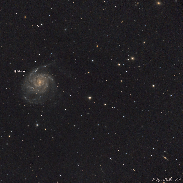
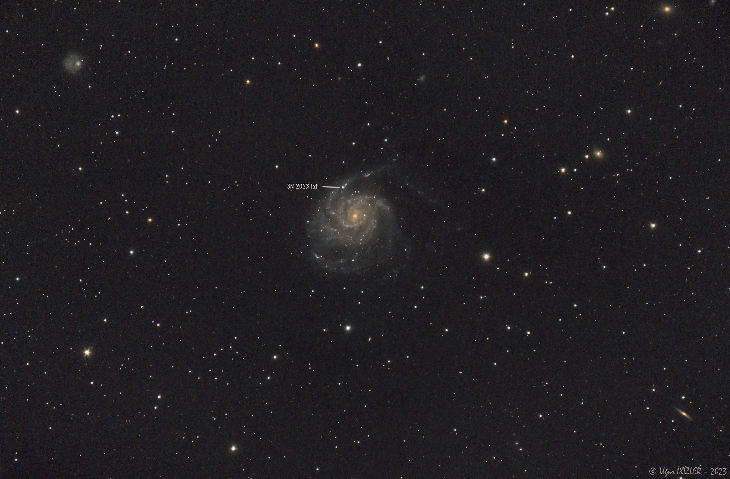
SN 2023 ixf
Taken by Uğur İkizler on June 6, 2023 @
Mudanya - Bursa - Turkiye
Click photo for larger image

| |
Camera Used: Unavailable Unavailable
Exposure Time: Unavailable
Aperture: Unavailable
ISO: Unavailable
Date Taken: Unavailable
|
|
| More images
Details:
Supernova at M 101 – SN 2023 ixf
A nearby star has exploded and humanity's telescopes are turning to monitor it. The supernova, dubbed SN 2023ixf, was discovered by Japanese astronomer Koichi Itagaki three days ago and subsequently located on automated images from the Zwicky Transient Facility two days earlier. SN 2023ixf occurred in the photogenic Pinwheel Galaxy M101, which, being only about 21 million light years away, makes it the closest supernova seen in the past five years, the second closest in the past 10 years, and the second supernova found in M101 in the past 15 years. Rapid follow up observations already indicate that SN 2023ixf is a Type II supernova, an explosion that occurs after a massive star runs out of nuclear fuel and collapses. The featured image shows home spiral galaxy two days ago with the supernova highlighted, while the roll-over image shows the same galaxy a month before. SN 2023ixf will likely brighten and remain visible to telescopes for months. Studying such a close and young Type II supernova may yield new clues about massive stars and how they explode.
Source: https://science.nasa.gov/supernova-discovered-nearby-spiral-galaxy-m101
Although this supernova was discovered on May 19, 2023, it is worth noting that this event actually happened 21 million years ago, and because of the distance, its light only reached us after such a long time. Although Nasa refers to it as a "close star" in its description, it is not as close as it seems. 😊
Home made Newtonian telescope ( 150 mm f/4,57 - Home made mount - Canon EOS 6D Full Spectrum - ISO 1600 - 92 x 45 sec. exposure
Photographer's website:
No URL provided.
|
|
|