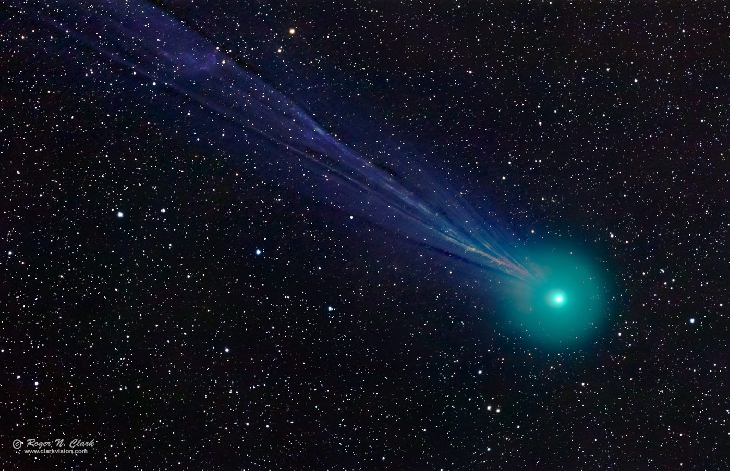
Comet Lovejoy
Taken by Roger Clark on January 15, 2015 @
Mauna Kea, Hawaii
Click photo for larger image

| |
Camera Used: Unavailable Unavailable
Exposure Time: Unavailable
Aperture: Unavailable
ISO: Unavailable
Date Taken: Unavailable
|
|
| More images
Details:
Comet Lovejoy C/2014 Q2 shows an intricate ion tail On January 12, 2015. Image from Mauna Kea, Hawaii at the 9,200 foot level. This image was obtained with a Canon 7D Mark II 20-megapixel digital camera and 300 mm f/2.8 L IS II lens at f/2.8 and ISO 1600. No dark frame subtraction, no flat fields. Tracking with an Astrotrac and no guiding. The 10.5 minutes total exposure (twenty one 30-second exposures).
During the approximately 16 minutes to make the exposures, the comet moved significantly. The 21
exposures were aligned in two ways: align on the comet head so the combined image had stars trailing, then align on the stars with the comet trailing. For the align on the comet image, the stars were
deleted, and for the align on the stars image, the comet was deleted, then the two images combined. To delete stars and not destroy detail in the comet's tail, I found that methods on the internet were
poor, so I deleted the stars using the healing brush in photoshop in a long and tedious process.
Removing the comet was easier: use the comet only image, blur it and subtract it from the image
aligned on the stars.
Modern DSLRs like the 7D Mark II include on sensor dark current suppression and low fixed pattern
noise at ISOs around 1600 and higher, making no need for dark frame subtraction. Modern raw converters correct for light fall-off and also correct for hot/dead/stuck pixels. This makes processing low light images easy: simply align and average.
Photographer's website:
http://www.clarkvision.com/
|
|
|